


Most startups treat failure like exhaust.
A blocked fraud attempt becomes a support ticket. A route that didn’t work becomes a driver complaint. A diagnosis that gets corrected becomes a quiet “phew” and a closed chart. Then everyone moves on.
But “negative data” isn’t exhaust. It’s ore.
When Homejoy shut down in the summer of 2015, the obituary was about labor law. The company had raised about $40 million from investors including Google Ventures and First Round, and it blamed its closure on the worker-classification lawsuits that made a Series C impossible to raise. Acquisition talks with its biggest competitor went nowhere, and the company failed to raise enough money to keep operating. That’s the story that made the headlines.
The quieter story is what happened to the assets. Some of the value survived the shutdown — Google reportedly hired about twenty people from the engineering team, and a cofounder relaunched Homejoy’s domain and customer and provider data as a new venture called Fly Maids. But that reuse was messy: former users were alarmed to find their old accounts including saved payment details, live on a copycat site they’d never signed up for.
What stayed unclear is the part that mattered most. There is no public evidence that the deeper operational learning — retention patterns, the route economics that never penciled, cleaner-reliability signals, city-by-city playbooks, the marketplace edge cases — was ever packaged as a transferable asset. What we can see is that it scattered across people, databases, and post-shutdown controversy. Three years of the most expensive test of the on-demand model anyone had run, and the hardest-won learning leaked rather than compounded.
That’s the pattern:
A failed logistics startup knows which routes don’t pencil.
A defunct fraud company has every attack pattern it successfully blocked.
A shuttered medical AI has seen the corrections — the edge cases where the system was confidently wrong.
The residual value is real.
But unless someone intentionally packages, permissions, and transfers it, that value leaks, fragments, or becomes legally and commercially unusable.
The question isn’t why startups fail. It’s why we let their hardest-won learning leak away.
Why negative data is different
Startups are built on small numbers — Early users | Early revenue | Early wins
That’s also why positive data can lie to you…
Your first hundred customers likely share a profile: similar channel, similar use case, similar tolerance for rough edges. Their success behavior is narrow. It teaches you how to win with friendly traffic — and almost nothing about what happens when traffic stops being friendly.
Negative data is broader, and it arrives faster. A fraudster is a researcher with a deadline. A logistics failure is a physics experiment you didn’t consent to. A corrected diagnosis is a reminder that the map is not the territory. Each “no” contains structure: the exact conditions where your product stopped being true.
In machine learning, these are called hard negatives — examples that look like a win until you inspect them closely. They’re the cases that force a model to learn the real boundary instead of the flattering one.
Startups have the same problem. You don’t need more happy-path usage.
You need to understand what almost worked but failed, what worked but shouldn’t have, what looked safe but wasn’t, and what looked risky but was legitimate.
Positive data makes you feel right. Negative data makes you useful.
And in markets where anyone can copy your features, useful under pressure is the part that’s hard to copy.
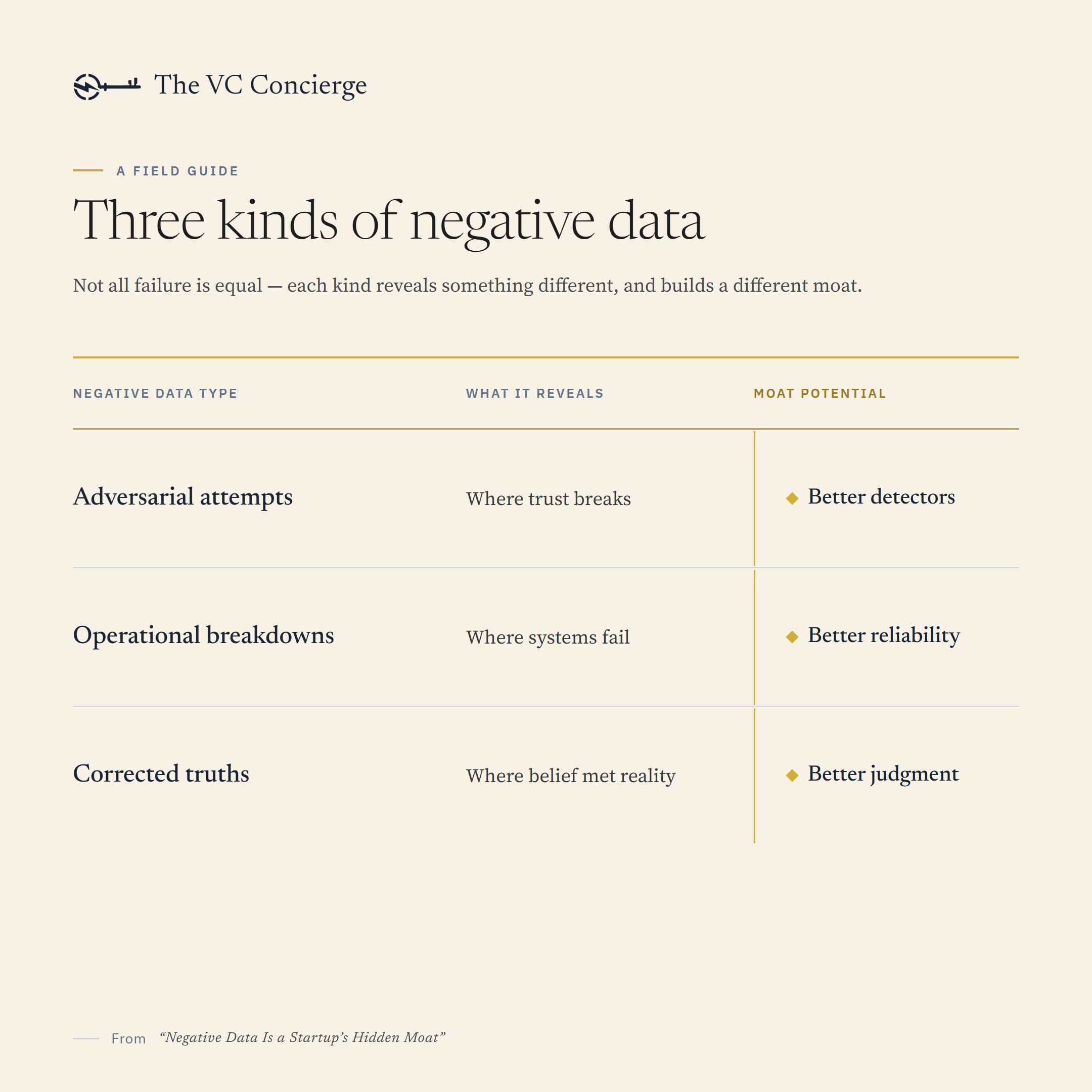
Three categories worth hoarding
Adversarial attempts — fraud, abuse, gaming, policy evasion.
A blocked fraud attempt is not “nothing happened.” Something happened: someone tested your perimeter and found a seam. The move isn’t block-and-forget.
It’s label the attempt, preserve the context, and learn the signature. Adversaries return, so every attempt is a chance to build a sharper detector — fewer false positives, fewer false negatives, less manual review, smoother conversion for real customers.
That’s not just risk reduction. Trust is growth.
The cost of getting this wrong is measurable. False positives sandpaper a business: you decline good customers, train your team to distrust their own tools, and call the lost revenue “market noise.”
One research paper on card-fraud prediction found that automated behavioral feature engineering reduced false positives by 54% on an unseen dataset of 1.852 million transactions. That’s one study, not a law of every fraud system — but the underlying move generalizes:
negative data pulls you away from optimizing for “looks good in the dashboard” and toward optimizing for “survives contact with the world.”
Operational breakdowns — routes, supply chains, latency, handoffs, edge-case workflows.
In operations, negative data hides in plain sight: canceled jobs, timeouts, reroutes, “driver arrived but couldn’t complete, “delivered” followed by “actually, no.”
This isn’t ops noise. It’s product signal.
Every failed handoff is a clue about incentives, constraints, and missing context.
Treat them as isolated fires and you’ll keep hiring firefighters.
Treat them as repeatable failure modes and you build a system that needs fewer heroes.
Corrected truths — diagnoses, compliance decisions, underwriting, QA.
Corrections are gold because they’re rare and specific.
A corrected diagnosis isn’t simply “we got it wrong.” It’s the system believing one story until reality forces a new one — and that gap between belief and reality is where the learning lives.
Healthcare has spent decades on this for a reason: researchers estimate that diagnostic errors affect roughly 5% of U.S. adults in outpatient care each year — more than 12 million people.
In high-stakes domains, a correction loop isn’t a nice-to-have. It’s the product. If you don’t build one, the market will build it for you — through churn, bad press, or regulators.
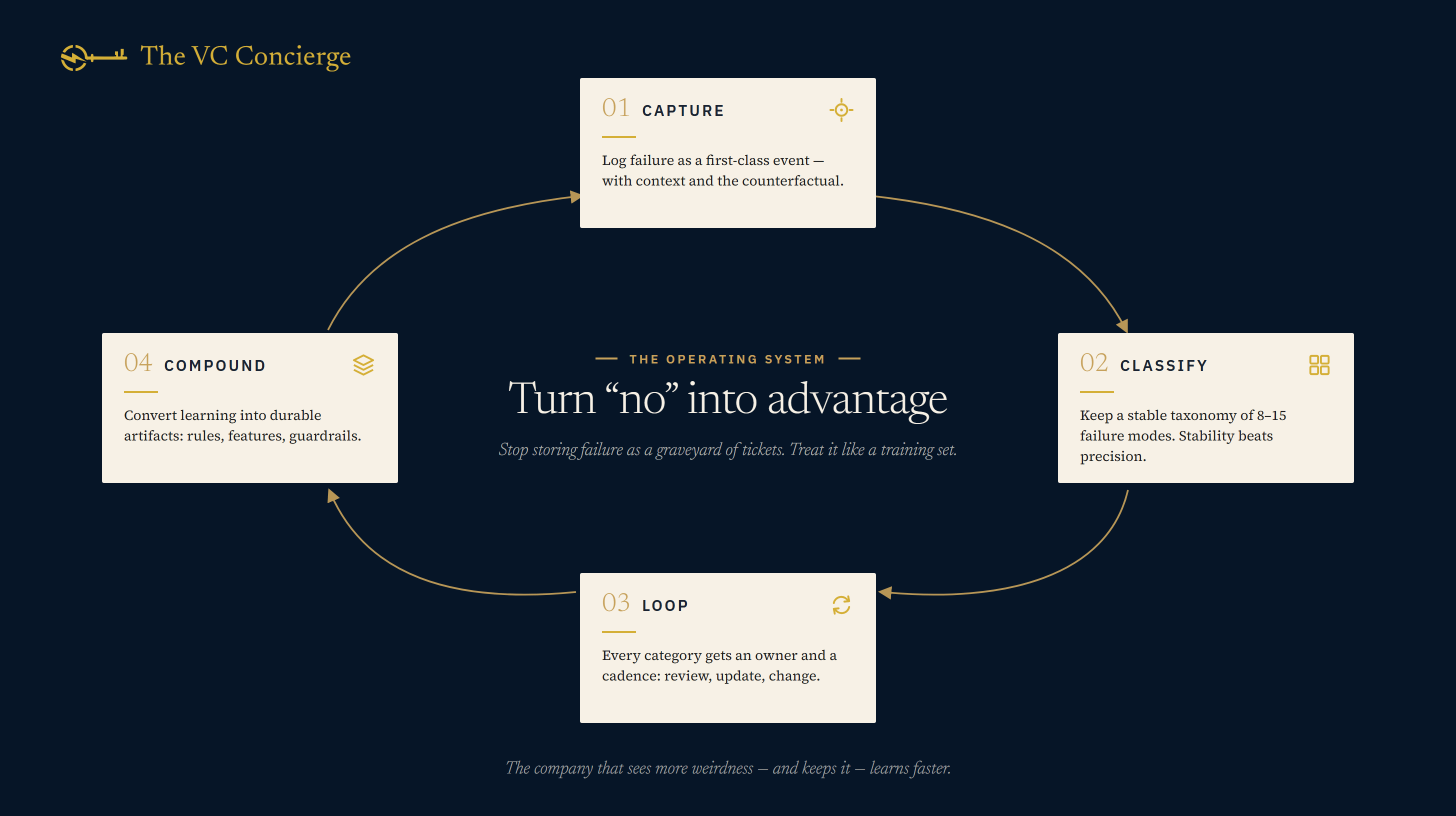
The operating system: capture, classify, loop, compound
Most teams already experience negative data. They just don’t operationalize it. The shift is to stop storing failure as a graveyard of tickets and start treating it like a training set.
Capture. Instrument failure as a first-class event — with the same dignity as “purchase” or “activation.” Not just “it failed,” but the context: sequence, timing, environment, user intent, and the counterfactual. What would success have looked like here?
Classify. Maintain a lightweight taxonomy of failure modes — eight to fifteen buckets is plenty. Stability beats precision early. “Other” is fine until it becomes your biggest bucket.
Close the loop. Every category needs an owner and a cadence: weekly review, monthly model update, quarterly product change.
Compound. Convert the learning into durable artifacts — rules that prevent repeats, model features, playbooks, UI guardrails, pricing and policy changes that reshape incentives.
Aviation is the cleanest version of this. It didn’t get safe by celebrating perfect flights. It got safe by treating near-misses as learnable data. NASA’s Aviation Safety Reporting System has collected more than two million confidential, de-identified reports since 1976 and feeds the patterns back to the whole industry. Startups can borrow the model without borrowing the bureaucracy.
The moat: why edge cases are defensible
If your advantage is “we have a feature,” you’re renting your future. If your advantage is “we have the edge cases,” you’re starting to own it.
The reason is path dependence. Two companies can start with the same model, the same vendor stack, the same cloud.
But the one that sees more weirdness — and keeps it — learns faster.
It ships safer automation, expands into harder segments, prices with confidence, and reduces churn its competitors keep explaining away.
This is also why network effects in fraud and risk feel different from network effects in social products. A system that learns from broad patterns across many businesses can spot repeat attackers, emerging tactics, and “looks risky but is legit” behavior sooner than any single company could alone.
The startup version of that is simpler: your negative dataset becomes your private map of reality, and reality is the one thing a well-funded competitor can’t clone overnight.
The risks: where this cuts the wrong way
Negative data is an asset, but it’s a governed one.
Privacy. Failures often carry sensitive context, and a shutdown is exactly when governance tends to lapse.
When Homejoy’s customer data resurfaced on a cofounder’s new site it became a cautionary tale rather than an asset.
De-identify early, restrict access, and set retention rules before the dataset becomes “too valuable to govern” and too ungoverned to use.
Bias. If your negative labels encode historical prejudice — “this looked risky” — you can train discrimination into the product.
Audit who gets labeled “bad,” and why.
Incentives. Punish incidents and people hide them. Reward clean dashboards and you’re paying for silence.
You want a culture where surfacing a failure is treated like shipping.
There’s a technical caution too. More hard negatives doesn’t automatically mean a better model; what you want is useful difficulty, tuned to the boundary you actually care about.
The same is true for companies. Don’t drown in failure. Curate it into learning.
If it works
Picture the business six months out. It feels calmer.
Support tickets drop — not because customers left, but because the common failure modes stopped happening.
Fraud attempts still come, but conversion climbs because you’re declining fewer real customers.
Routing becomes predictably reliable, so you can promise tighter SLAs and charge for them. Corrections in high-stakes decisions become a measured feedback stream instead of a PR risk.
Economically, that shows up as a lower loss rate, a lower false-positive cost, and higher retention.
In plain terms: fewer refunds, fewer manual reviews, fewer “we blocked your card” moments, fewer churned power users.
The business becomes less fragile, and the revenue becomes more trustworthy. What looks like ops maturity is actually a data moat.
You’re pricing reality, not vibes.
Serving the Vision
If you’re building, here’s where to start:
Make failure a first-class event.
Action: Add a negative-event schema [reason, sequence, environment, counterfactual] and enforce it across product, ops, and support, not just engineering.
Signal: more than 85% of negative events logged with complete context.Keep a stable failure taxonomy.
Action: Eight to fifteen labels, reviewed monthly, changed intentionally.
Signal: your top three failure modes account for a rising share — proof you’re seeing patterns, not noise.Run a weekly edge-case review.
Action: Not a postmortem; a production line for resilience. Every session ships one mitigation — a rule, a guardrail, a workflow change, a model tweak.
Signal: incident-to-mitigation time trends down.Turn the dataset into artifacts.
Action: The data is useful; the institutionalization is the moat.
Signal: Every top-three failure mode gets an owner, a playbook, and a prevention mechanism.
Closing shift
Your wins are loud. Your “almosts” are honest.
Negative data is where reality leaves fingerprints. The debris isn’t wreckage — it’s direction. Archive your failures, label them, learn them, and the most expensive thing that ever happened to your company quietly becomes the thing competitors can’t buy.
Belief becomes capital.
But the data in the debris becomes infrastructure — and there is founder in your space is building a map.
Don’t let it burn.
If your moat is hiding in your edge cases, The VC Concierge writes about the patterns that make founders defensible.
Contextual Sources
Homejoy shutdown, funding, failed acquisition talks, and worker-classification lawsuits: TechCrunch, July 17, 2015 and TechCrunch, July 31, 2015
Post-shutdown reuse of Homejoy’s domain and customer data as Fly Maids, and the resulting privacy backlash: Fast Company, Oct. 2015 and VICE/Motherboard, Oct. 2015
Outpatient diagnostic error rate (~5% / >12M U.S. adults/year): Singh, Meyer & Thomas, BMJ Quality & Safety (2014), 23(9):727–731
NASA Aviation Safety Reporting System — confidential, de-identified near-miss reporting (2M+ reports since 1976): ASRS Program Overview
Reducing false positives in fraud via behavioral feature engineering (54% reduction on ~1.85M transactions): Wedge et al., “Solving the ‘false positives’ problem in fraud prediction,” arXiv:1710.07709 (2017)
Hard-negative mining (one example of the technique in modern ML; the concept is broader than this single paper): Fan et al., ACM Transactions on Software Engineering and Methodology (2025)
Networked, network-scale fraud learning: Stripe Radar