

There is a comforting myth in startups: the breakthrough arrives like lightning.
One day the right investor calls back. One customer says yes. One distribution partner opens the floodgates. One product moment clicks, and the company’s story suddenly looks inevitable.
Here is the reframe, informed by science:
Parasites do not become organs. They get rejected, or they kill the system.
Breakout companies are not the ones that got lucky. They are the ones that became so useful, so embedded, and so genuinely mutual inside a customer’s life that biology’s oldest rule took over — two systems started functioning like one.
That is the move. Everything else in this essay is the operating manual.
When a relationship becomes machinery
In 2024, scientists at UC Santa Cruz confirmed something researchers had suspected for years, and gave it a name: the nitroplast.
The paper earned science’s oldest prize. The metaphor it contains is worth more than the headline.
The subject is a marine alga, Braarudosphaera bigelowii, and a bacterium, UCYN-A, that lives inside it. For decades, UCYN-A looked like an unusually intimate partner — a guest, but still a separate organism. Then the evidence crossed a threshold. UCYN-A scales with the host’s cell size the way organelles do. It imports proteins made by the host. Its genome is streamlined in a way that signals long-term dependence, not casual cohabitation.
That was the moment the story changed from relationship to integration.
As Tyler Coale, the paper’s first author, put it:
“It’s very rare that organelles arise from these types of things. The first time we think it happened, it gave rise to all complex life. Everything more complicated than a bacterial cell owes its existence to that event.”
The origin of organelles through primary endosymbiosis has only happened a handful of times in the record of life. It previously gave us mitochondria and chloroplasts. We now have a third confirmed case.
The biology took an eon. Your company has roughly 24 months. The compression is the point.
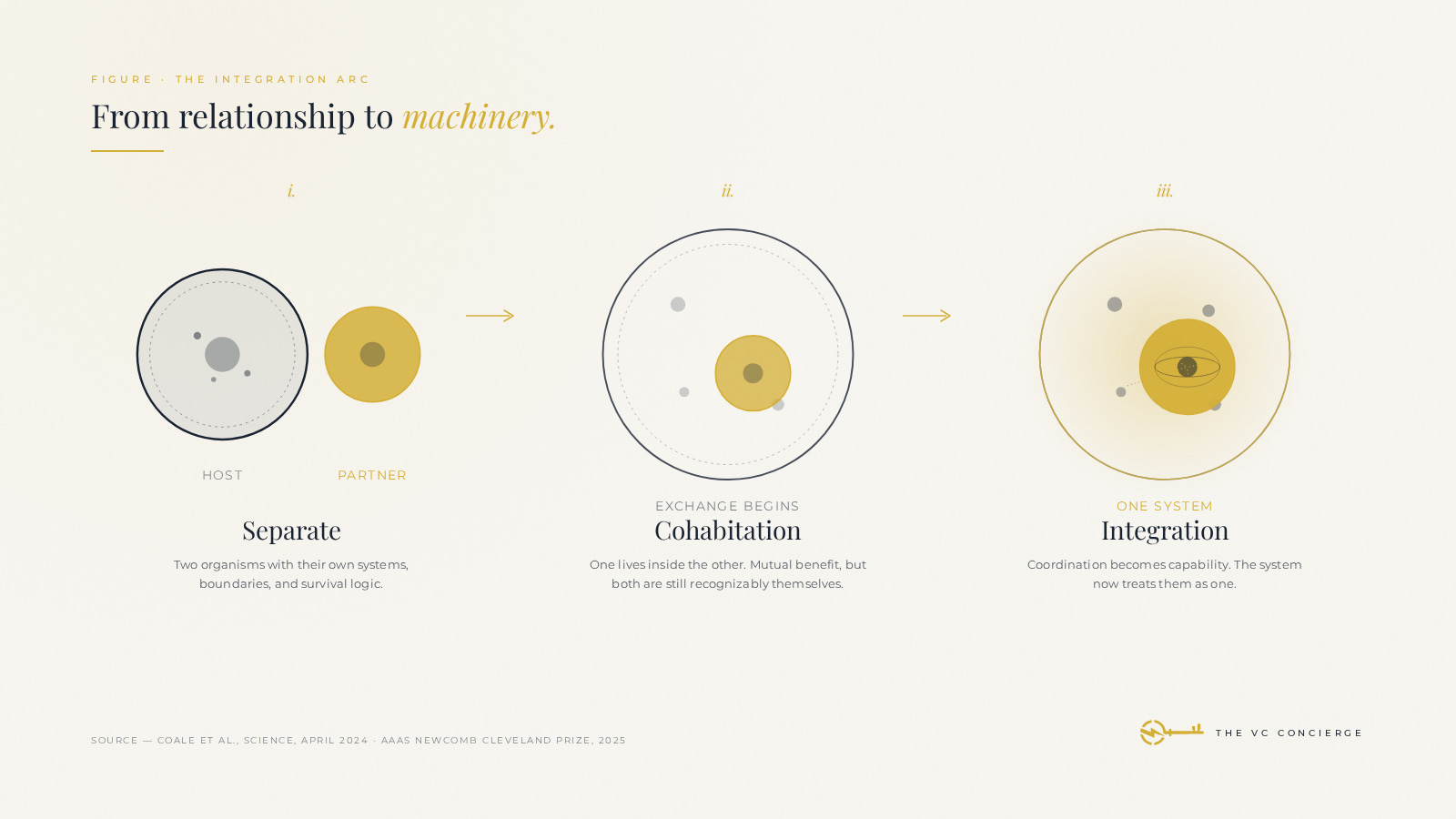
Over a long enough timeline — or a short enough one — the interface between two organisms becomes tight enough, reliable enough, and useful enough that the system starts treating them as one. Proximity becomes dependence. Dependence becomes coordination. Coordination unlocks a new capability.
That is not lightning. That is construction.
In biology it is slow construction. In startups it is urgent construction. Same rule.
The founder’s job is not to chase miracles
In startups, people talk about luck as if it lives outside the building.
But the most valuable kind of luck is engineered. It shows up when a company is designed to make rare outcomes more likely, then more repeatable.
A simple model:
Rare outcome = Alignment × Time × Interface
Alignment — are you solving a real, repeated, painful problem?
Time — do you have enough runway, belief, and stamina for compounding to work?
Interface — do you have a tight loop with the market that allows reality to shape you fast?
Most founders spend time on alignment. Many obsess over time. Fewer treat interface as a first-class operating system.
They should.
Interface is where the company stops presenting itself to the market and starts absorbing it. Customer feedback becomes product instinct. A use case becomes a workflow. A distribution relationship becomes embedded motion. What used to be external becomes something the company can count on.
Ambition is ancient. The tools are new. The companies that win the next decade are the ones that use the new tools to compress what used to take generations into something that fits inside a seed round.
Why this matters more now
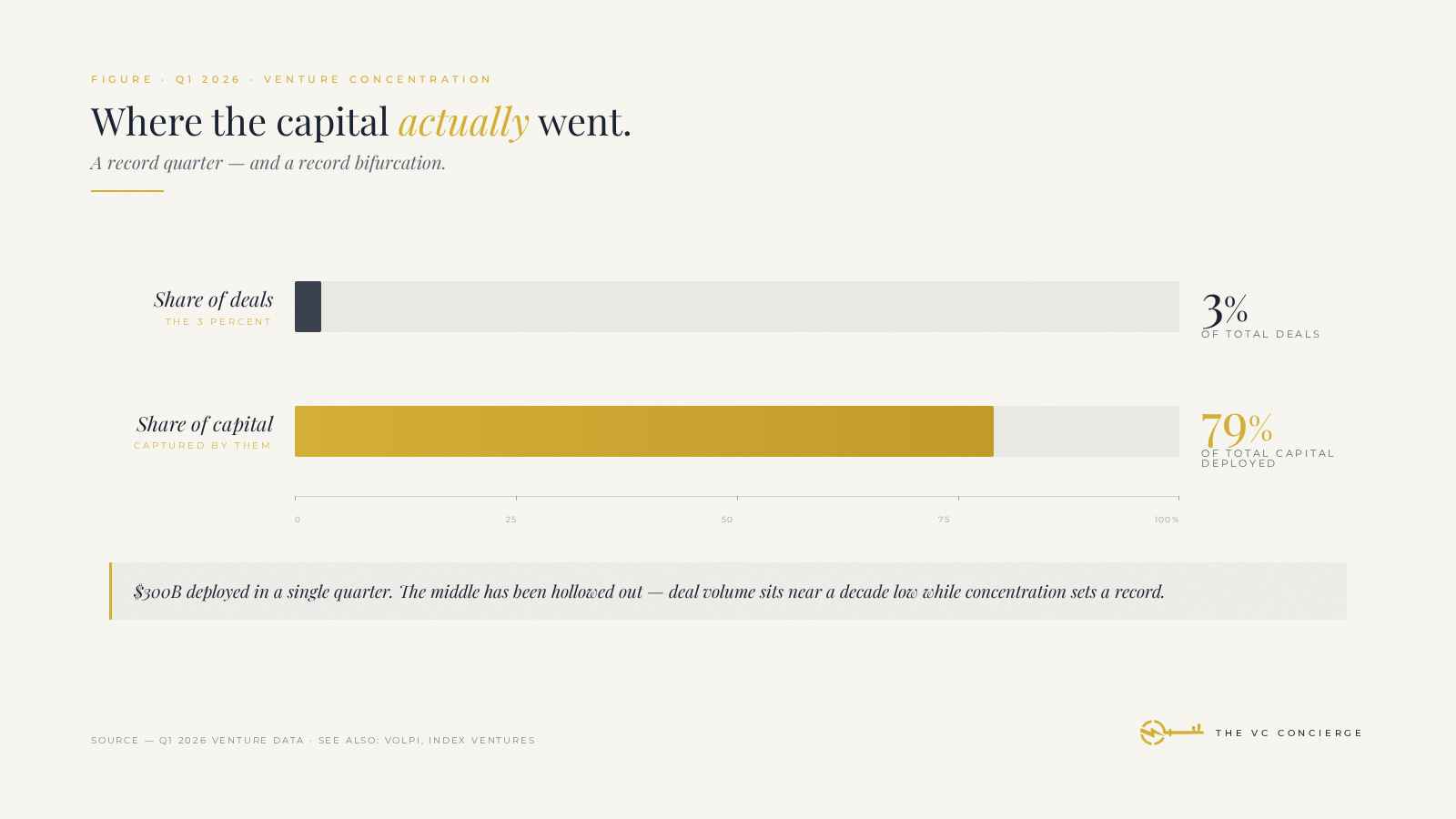
Q1 2026 broke every record in venture history — $300 billion poured into global startups in a single quarter. But the distribution is the story: fewer than 3% of deals captured more than 79% of all capital. Deal volume globally is near its lowest point in a decade. Seed funding is up 31% year-over-year — while the number of seed deals fell 30%.
Mike Volpi at Index Ventures described it plainly:
“You have a handful of companies raising rounds that look more like sovereign debt issuances, and then you have everyone else competing for a shrinking pool of capital. The middle has been hollowed out.”
The data underneath is unambiguous. Only 15.5% of companies that raised seed in early 2023 made it to Series A within two years. The median seed-to-Series A interval has stretched past 616 days.
The winners are not always the teams that raised the most. Often they are the teams that built internal systems strong enough to keep compounding while the market took longer to decide.
In a tighter environment, time is not just something you survive. It is something you convert.
The money follows momentum. Momentum follows integration.
What integration actually requires
One distinction is worth holding onto:
Parasites do not become organs. They get rejected, or they kill the system.
The nitroplast worked because the exchange was genuinely mutual. UCYN-A delivered fixed nitrogen. The alga delivered everything else UCYN-A needed to survive. Integration only lasts when both sides are getting something they cannot replace.
The same rule holds in startups.
You do not earn deep integration by trapping customers, manufacturing friction, or dressing up weak value with better branding. You earn it by becoming meaningfully useful inside a workflow that matters.
That means shifting from:
pitching → proof loops
networking → compounding relationships
shipping features → shipping and absorbing
growth spurts → growth systems
hoping customers understand → making customers feel the difference
That last one matters more than most founders admit.
Relief is data. Confusion is data. Obsession is data. Trust is data.
If your customer cannot feel the difference between using your product and not using it, you are still adjacent to their life. You are not integrated into it. You are a hitchhiker, and hitchhikers get expelled.
If It Works…
Picture your company 12 months from now.
Not the vanity version. Not the press hit. Not the logo slide. Not the round announcement.
Picture this: your company has built one internal organ — a capability that runs even when you are tired.
Customer discovery is no longer a phase. It is a rhythm. Distribution is no longer a hope. It is a repeatable motion. Product learning is no longer occasional. It is built into the way the company works.
Then the economics begin to change. Retention improves because the product is anchored in real workflow. CAC falls as referrals and embedded channels start to do more of the work. Insight turns into shipped improvement faster. The same effort produces more value per unit of time.
That is what rare looks like when it becomes repeatable.
Not a spike. A capability.
Belief becomes capital when the capability becomes visible.
Serving the Vision
Five moves. In sequence. Skip one and the architecture stays permeable — you stay a hitchhiker.
1. Build the interface, not just the product
Most founders treat feedback like a suggestion box. Treat it like life support. Build a consistent loop where the same kinds of users show you their reality and your team turns that reality into shipped change.
Action: Run five structured customer sessions a week for six weeks.
Signal: Time from insight to shipped change starts compressing.
2. Earn dependence the right way
Pick one core job your user does repeatedly and make your product unmistakably better at that job. Not more impressive. More indispensable.
Action: Redesign onboarding around one weekly use case and get users to value faster.
Signal: Retention rises and users start saying some version of “I can’t go back.”
3. Write a runway thesis
Time only compounds if it is directed. With the median seed-to-Series A interval now past 600 days, the founders who survive are not the ones who waited — they are the ones who treated every quarter as a compounding cycle.
Action: Set one proof milestone each for product, distribution, and customer value in the next 90 days.
Signal: You can explain your next raise or your path to sustainability in three sentences with numbers.
4. Turn partnerships into shared motion
Most partnerships stay polite. Integration requires cadence, incentives, and operational overlap. The goal is not access. The goal is embedded movement.
Action: Run a 30-day pilot with one partner around one shared customer profile and one shared offer.
Signal: Partner-sourced pipeline becomes consistent instead of occasional.
5. Instrument the emotional arc
Founders measure clicks and ignore feelings until churn forces the lesson. But confusion, relief, confidence, and delight are early indicators of whether your product is becoming part of a real workflow.
Action: After first value, ask two questions: “How did this feel?” and “What almost stopped you?”
Signal: Confusion trends down. Relief and confidence trend up. Support burden drops with them.
Closing Shift
Rare things happen.
But integration has a cost most founders do not see until they are inside it. The alga cannot expel the nitroplast now. The capability is real. The dependency is permanent. You do not get to un-integrate.
The company that becomes an organelle in its customer’s workflow has built something real — and has also accepted that its future is bound to that workflow’s survival. The partner that becomes an embedded channel is also a single point of failure. The capability that runs even when you are tired is also the capability you are now obligated to sustain.
This is not a reason to avoid it. It is a reason to build it deliberately — to earn the integration rather than engineer it, to make the dependency mutual rather than extractive, to choose the workflow you are willing to be inside for the long run.
Because the market does not reward hope. It does not reward the appearance of integration either.
It rewards the real thing.
The company that lasts is not the one that hoped hardest. It is the one that became real inside someone else’s life.
So here is the imperative:
Pick one workflow. Become impossible to remove from it. Start this week.
Not next quarter. Not after the raise. Not after the rebrand.
Five customer conversations. One workflow. One week.
If you cannot do that, no amount of capital, runway, or market timing will make you rare.
If you can — the rare thing is already starting.